
Three paths at a glance
- DIY
- Terraform, Helm, scripts, wiki
- Qovery
- Multi-cloud platform with CI/CD
- Clusterward
- Control plane for Scaleway only
- Same for all
- Kapsule, standard Kubernetes
- Biggest difference
- Price and customer onboarding
If you run Kubernetes on Scaleway, you have three options: build it yourself, buy a multi-cloud platform like Qovery, or use a control plane built only for Scaleway. Here you can see all three side by side – with numbers, and with the places where the others are better.
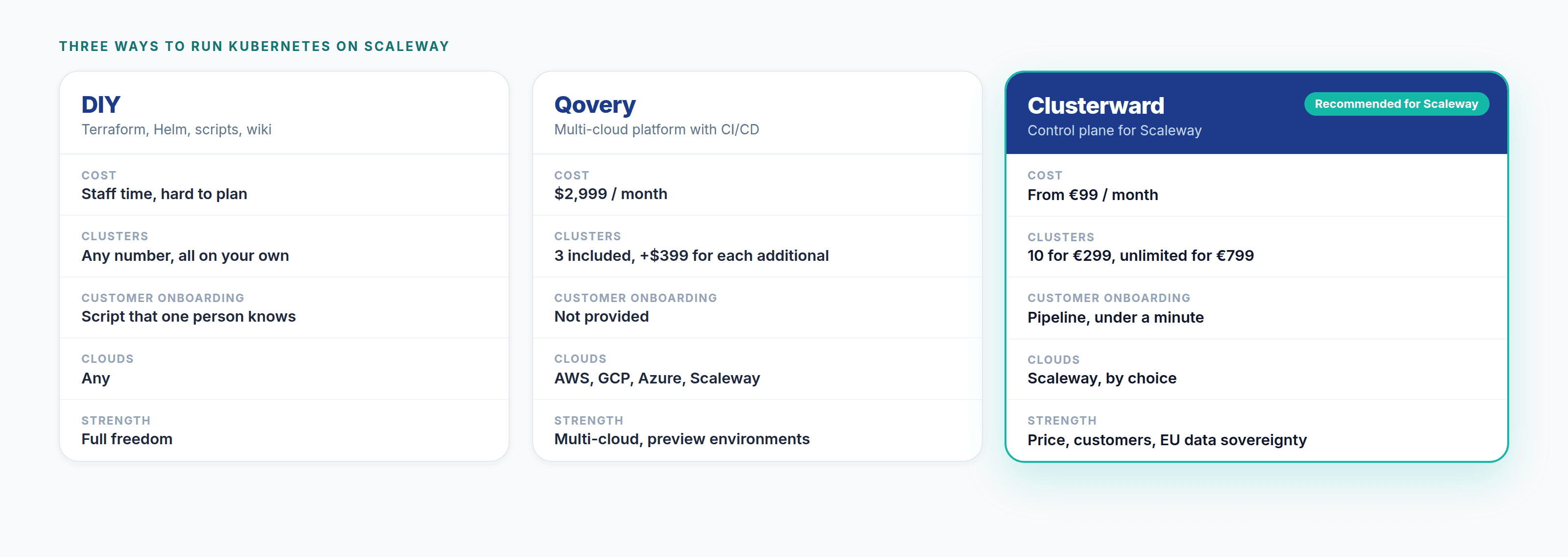
Comparing Kubernetes platforms means checking three things: what they cost, what they take off your team’s plate and where your data lives. A Kubernetes platform is the layer above the cluster that manages deployments, databases, domains, certificates and access – bought, like Qovery and Clusterward, or built yourself from Terraform, Helm and scripts.
The cluster itself is the same on all three paths: Scaleway Kapsule in your project. The difference is who does the work on top of it – and what that costs.
Qovery figures from the public pricing page (Business plan, billed annually), as of September 2026. The details are in the two individual comparisons.
| Criterion | DIY | Qovery | Clusterward |
|---|---|---|---|
| Price per month | No license, but staff time | $2,999 | From €99 |
| Clusters | Any number | 3, each additional $399 | 10 for €299, unlimited for €799 |
| Users | Any number | 20 | Unlimited |
| Cloud providers | Any | AWS, GCP, Azure, Scaleway | Scaleway |
| Customer onboarding | Script, usually without rollback | Not provided | Pipeline with offboarding and backup |
| Preview environments | If someone builds it | Yes | No |
| Secrets | Manual | Variables per environment | Secret manager with rotation |
| Monitoring | Your own stack | Observe package, $299 per cluster | Logs, uptime, alerts included |
| Data sovereignty | However it was built | Vendor in France | Vendor in Hannover, EU |
Qovery Business costs $2,999 per month for three clusters and twenty users; Clusterward Team costs €299 for ten clusters and unlimited users. Plus data sovereignty, cloud coverage and the migration path.
Read the comparisonThe most common competitor is your own stack. What it means in terms of work, which safety nets are usually missing, and the three cases in which it is still the better choice.
Read the comparisonEvery path has cases where it wins. We say the same three things in the demo.
… you need operators, service meshes or custom CRDs, also run AWS, Hetzner or on-premises, or have an ops team that enjoys running Kubernetes itself and has the time for it.
… you run several cloud providers in parallel, need preview environments per pull request, or require evidence such as HIPAA or DORA from the Enterprise plan.
… you run on Scaleway, want to create customers via a pipeline and tear them down cleanly again, have a small team without an ops department and need predictable costs.
Platform fee only, per month, excluding cloud resources. Scaleway costs are the same on all three paths, because the resources are created in your own project. DIY costs no license, but it costs your team’s hours.
| Clusters | DIY | Qovery Business | Clusterward |
|---|---|---|---|
| 3 | Staff time | $2,999 | €299 (Team) |
| 10 | Staff time | $5,792 | €299 (Team) |
| 20 | Staff time | $9,782 | €799 (Platform) |
| Users included | Any number | 20 | Unlimited |
Standard objects on Scaleway Kapsule, readable with kubectl and usable without Clusterward.
Charts from the library, certificates from cert-manager, nothing proprietary in the cluster.
Clusters, databases and buckets belong to your project and your bill, in every scenario.
If you use Qovery today, you’ll find the migration path under Migrating from Qovery; if you’re coming from AWS, Azure or Google Cloud, see Moving from AWS, Azure or Google Cloud.
The plans with all their details are on Pricing, and the Glossary explains the terms from both comparisons. If you want to try Clusterward right away, start with Getting started.
Can’t find your question? Write to us – we usually reply on the same business day.
Ask a questionIn the demo, we compare Clusterward with your current solution – on your applications instead of on spreadsheets.