Clusterward
For agencies & studios

For agencies: all client projects in one cockpit

Twenty clients, twenty stacks, one team. Clusterward rolls out applications from Git, creates a database and domain with a click and gives every client and every freelancer exactly the access they need.

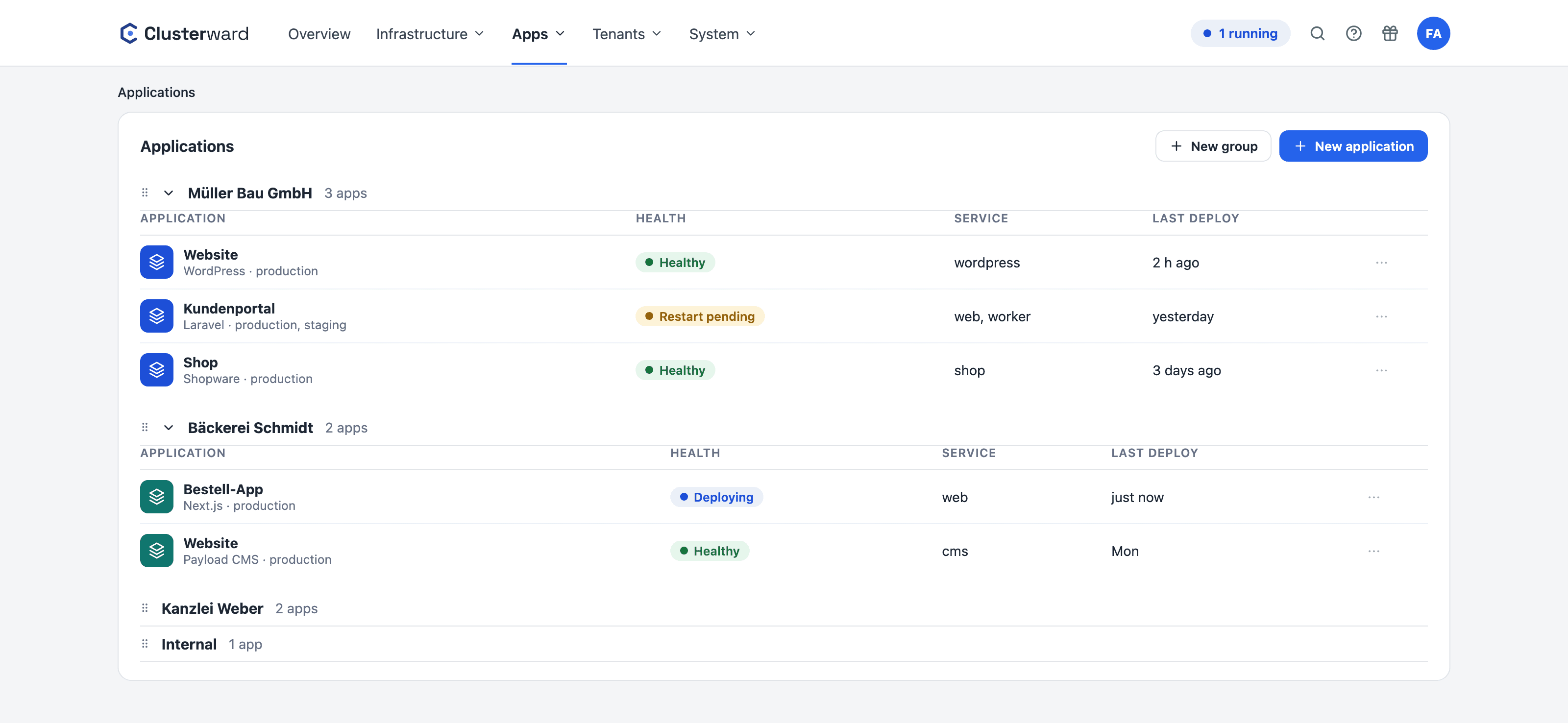
Applications in the cockpit: client projects in groups, with health status and last deployment per service
Simplified view in the Clusterward cockpit: applications grouped by customer
Illustration: a simplified view. The product shows more details and options.
In brief

What Clusterward does for agencies

For agencies, Clusterward is the cockpit that holds all client projects on Scaleway Kubernetes. Each project is an application with environments, services and builds; applications can be organized into groups, for example per client. A client or freelancer gets a role with an application scope and sees only their own projects. Deployments come from Git, the database and domain are created on the service page, and environment variables are stored encrypted in the cockpit. One cluster carries many projects in separate namespaces; anyone who needs isolation gets a dedicated cluster in a dedicated Scaleway project.

At a glance

Projects
Unlimited, grouped per client
Access
Roles with application scope, mandatory 2FA
Deployments
From Git, a container image or a Helm chart
Database and domain
On the service page, one click
Isolation
Namespace per project, cluster per client possible
Plan
By cluster, users and projects included
How it works

From kickoff to go-live

  1. 01

    Create the project

    Application with repository, build and environments such as staging and production.

  2. 02

    Invite the team

    Developers operate, the client views, the freelancer sees only their project.

  3. 03

    Database and host

    Create the database on the service page, enter the domain, and the certificate follows on its own.

  4. 04

    Roll out

    Deployment from Git with a health check, restart on configuration changes.

  5. 05

    Hand over

    The client gets read access to their project and alerts in their own channel.

What’s included

What agencies get in Clusterward

The operations work that is otherwise scattered across Hetzner boxes, Vercel accounts and a folder of kubeconfigs.

Projects in groups

The applications overview organizes projects into groups, for example per client, with health status and last deployment per service. Order and membership apply to the whole team.

Access per client and freelancer

Roles assign one level per area; the application scope limits a user to their own projects. A client sees their project, a freelancer deploys only theirs. Every action in the audit log.

Deployments from Git

Branch, Dockerfile and image belong to the build. Kaniko builds in the cluster or GitHub Actions on GitHub runners, and the tag is verified before the rollout.

Database and domain with a click

On the service page, the database is created with a role and password in one step, and the host gets a record and certificate. Connection details ready to copy in the cockpit.

Templates for variables

Recurring sets of variables as a template, copied into the project on creation. Multi-line values such as keys stay intact.

Alerts per client

One channel per client: failed deployments, unhealthy pods and expiring certificates land in the right Slack or Teams channel, once per event.

WordPress sites from the catalog

A new WordPress client site is created from four fields: its own database, a disk with daily snapshots, a cron job and a certificate. Until setup is complete, a password protects the installer.

Standard building blocks

What sits behind every project

  • Scaleway Kapsule

    Managed Kubernetes in EU data centers, costs billed directly by Scaleway.

  • Kaniko and GitHub Actions

    Image builds without a build server, either in the cluster or on GitHub.

  • Managed Databases

    PostgreSQL or MySQL, connected privately, one database per service.

  • cert-manager and Cloudflare

    Records created automatically, certificates per host or as a wildcard.

What changes

Running projects with and without Clusterward

Facts

Roles in everyday agency work

A role assigns one level per area, plus the list of projects that have been shared.

PersonRoleSees and can
Project leadManage applicationsAll projects, invite users, delete
DeveloperOperate applicationsDeploy their projects, change variables, read logs
FreelancerOperate applications, one projectOnly the shared project
ClientView applications, one projectStatus, deployments and logs of their project
OperationsAdministratorClusters, databases, DNS, everything
Further reading

Dig deeper

How a project gets from commit to cluster is explained under Deployments. Roles, application scope and the audit log are described in Security & access.

If you equip clients with the same stack every time, such as a CMS per client, describe it once as a pipeline; see Tenant pipelines. What it costs is listed under Pricing: two clusters from €99 per month, unlimited projects and users.

WordPress from the app catalog walks through creating a WordPress site from the app catalog; the post WordPress on Kubernetes: seven traps between the chart and the first page covers the pitfalls of doing it yourself.

Related pages

What goes with it

Deployments

Git, container image or Helm chart – rolled out with a health check.

Go to Deployments
FAQ

Frequently asked questions about agencies & studios

  • No. One cluster carries many projects in separate namespaces; most agencies run one cluster for all their smaller clients and dedicated clusters only where a client requires isolation or their own Scaleway project. A dedicated cluster is created with the provisioning profile of the client’s project.

Can’t find your question? Write to us – we usually reply on the same business day.

Ask a question

Your first client project in the demo

We create one of your projects, roll it out from Git and set up access for the client and your team.