
Clusterward
DNS & certificates

DNS records and wildcard certificates, no console needed

Clusterward creates records in your Cloudflare zones, issues certificates per host or as a wildcard certificate, and only changes records it created itself or was explicitly given.

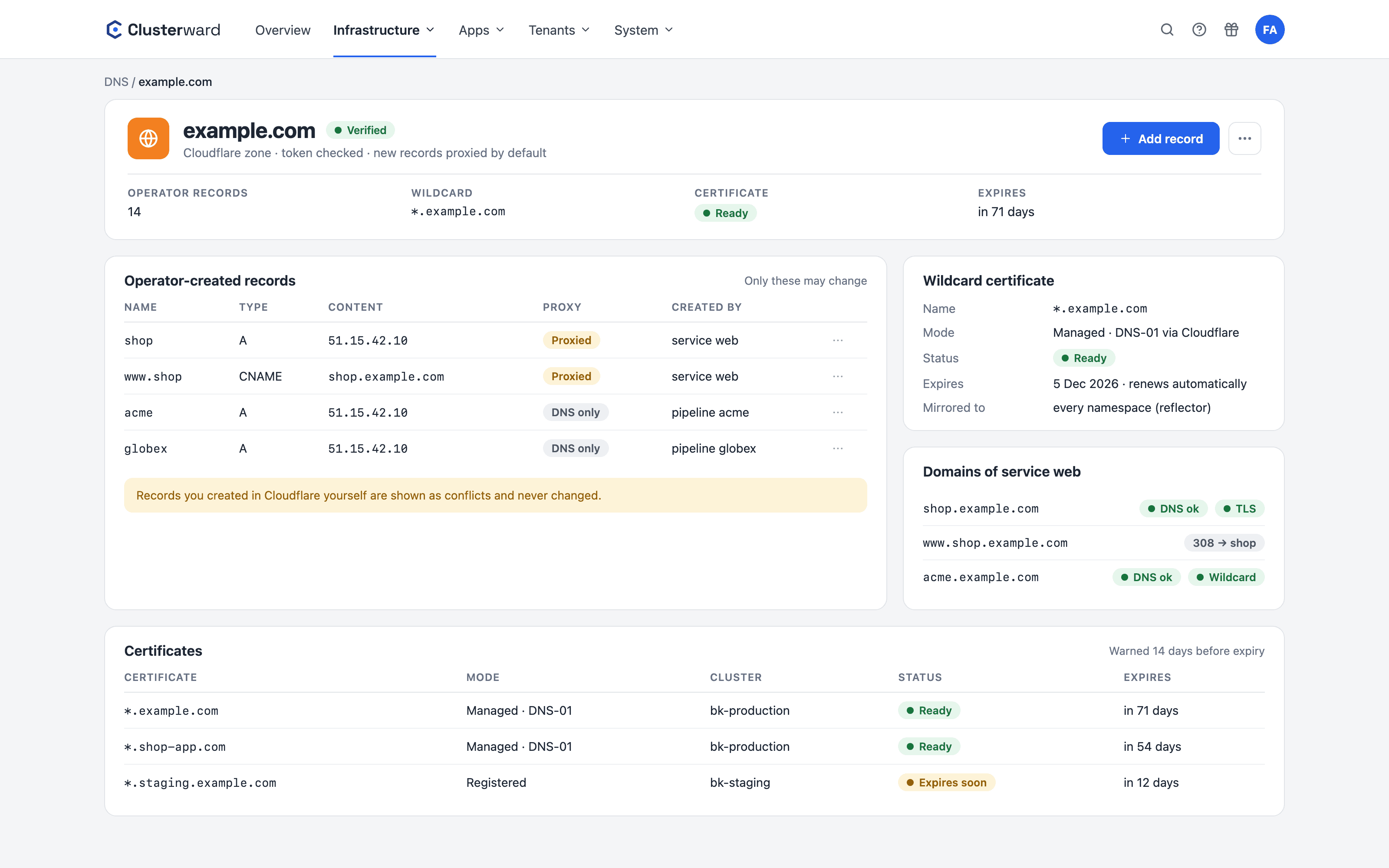
DNS zone and certificates in the Clusterward Cockpit
Simplified view in the Clusterward cockpit: DNS zone and certificates
Illustration: a simplified view. The product shows more details and options.
In brief

What DNS and certificates cover in Clusterward

In Clusterward, domains belong to the service: every host gets an ingress, a DNS record and a TLS strategy. Registered Cloudflare zones (token encrypted, verified before saving) allow records to be created automatically. For TLS, you choose per domain between a Let’s Encrypt certificate per host and a wildcard certificate that Clusterward issues itself via DNS-01 and mirrors into every namespace. Behind the Cloudflare proxy, Clusterward detects the host and skips issuing its own certificates.

At a glance

Zones
Cloudflare, token verified and encrypted
Records
Automatic, compared live, only its own or adopted ones are changed
TLS
Let’s Encrypt per host or wildcard via DNS-01
Proxy
Cloudflare proxy detected, proxy flag per record
Redirects
At Cloudflare’s edge or on the cluster, target with a path
Switching
Ingress controller cutover without downtime
How it works

From domain to green padlock

  1. 01

    Register a zone

    Enter your Cloudflare token; Clusterward verifies it against the zone and stores it encrypted.

  2. 02

    Domain on the service

    Enter the hostname, choose a TLS strategy or leave it on “auto”.

  3. 03

    Create the record

    An unclaimed host in a registered zone gets its record automatically.

  4. 04

    Issue the certificate

    cert-manager via HTTP-01 per host, or the wildcard certificate from the registry.

  5. 05

    Monitor

    Expiry within 14 days or a certificate that is not ready triggers a notification.

What’s included

What DNS and certificates in Clusterward do for you

The part of operations that is otherwise scattered across the Cloudflare dashboard, kubectl and your calendar.

Zone registry

Cloudflare zones with an encrypted token. Only verified zones match hostnames, by longest suffix.

The golden rule for records

Only records that Clusterward created, or that you explicitly handed to it, are ever changed; only its own are ever deleted. A foreign record shows up as a conflict and stays untouched until you adopt it.

Wildcard certificates

One certificate for all subdomains of a base domain, issued via DNS-01 and mirrored into every namespace. It covers the bare domain itself too. No per-host rate limits.

Proxy flag per record

A host set to “DNS only” for websockets stays that way after the next deployment. The setting belongs to the record, not the zone.

Redirects, at Cloudflare too

www to the apex, old domains to new ones, with a target path such as example.com/de if you like. Behind Cloudflare’s proxy a redirect rule answers right at the edge, otherwise a plain 301 from the cluster. Hosts can also be limited to source address ranges.

Controller switch without downtime

When switching from nginx to Envoy Gateway, both load balancers serve the hosts. Clusterward moves its own records and completes the cutover one hour after DNS has moved everywhere.

Live comparison with Cloudflare

Every registered zone is compared with Cloudflare every hour. A record changed in the dashboard shows as “changed at the provider” and is taken over instead of being written back on the next deploy.

Adopt records

Existing records of a zone can be adopted. Clusterward then changes them like its own, for example during a controller switch, but never deletes them at the provider.

Every host checked live

The Domains card reads every host’s record live and offers the matching button: point it at the address, create the record or adopt it.

Standards, not DIY

Standard tools, wired up by Clusterward

  • cert-manager

    Let’s Encrypt issuers for HTTP-01 per host and DNS-01 for wildcards.

  • Cloudflare API

    Records and zone verification via the official API, no SDK.

  • Reflector

    Mirrors the wildcard secret into every namespace automatically.

  • Ingress and Gateway API

    ingress-nginx or Envoy Gateway, rendered from a single description.

What changes

DNS and TLS with and without Clusterward

Facts

TLS strategies per domain

The strategy is chosen per domain. A service can mix hosts with different strategies.

StrategyIssuanceSuitable for
letsencryptcert-manager, HTTP-01, one certificate per hostA few fixed hostnames
wildcardRegistered or managed wildcard certificateMany subdomains, tenants
noneNo certificate of its own, TLS at the Cloudflare edgeHosts behind the Cloudflare proxy
autoDetects the Cloudflare proxy, otherwise Let’s EncryptThe default if you choose nothing
Further reading

How DNS fits in

Hosts are maintained on the service and rendered on the next deployment. In a pipeline, the domain building block takes care of the record and certificate for each tenant, as described under Tenant pipelines.

Which certificates are about to expire and whether a host is healthy – you find out via Notifications, without opening the cockpit.

Related features

What goes with it

Deployments

Git, container image or Helm chart – rolled out with a health check.

Go to Deployments
FAQ

Frequently asked questions about DNS & certificates

  • Registered zones are Cloudflare zones. Hosts in other zones work too: you create the record yourself, Clusterward waits for it to resolve and renders the ingress and certificate. Only the automatic creation of records requires a Cloudflare zone.

Can’t find your question? Write to us – we usually reply on the same business day.

Ask a question

Domain and certificate in the demo

We connect one of your domains, create the record and watch the certificate being issued.