Clusterward
Solutions

Managed Kubernetes on Scaleway: one platform, four roles, one way of operating

Whether you run a SaaS for many customers, host client projects as an agency, offer a platform with its own workspaces or, as a CTO, want operations that don’t depend on a single person: Clusterward turns Scaleway Kapsule into managed Kubernetes that fits your role – on the same foundation for everyone.

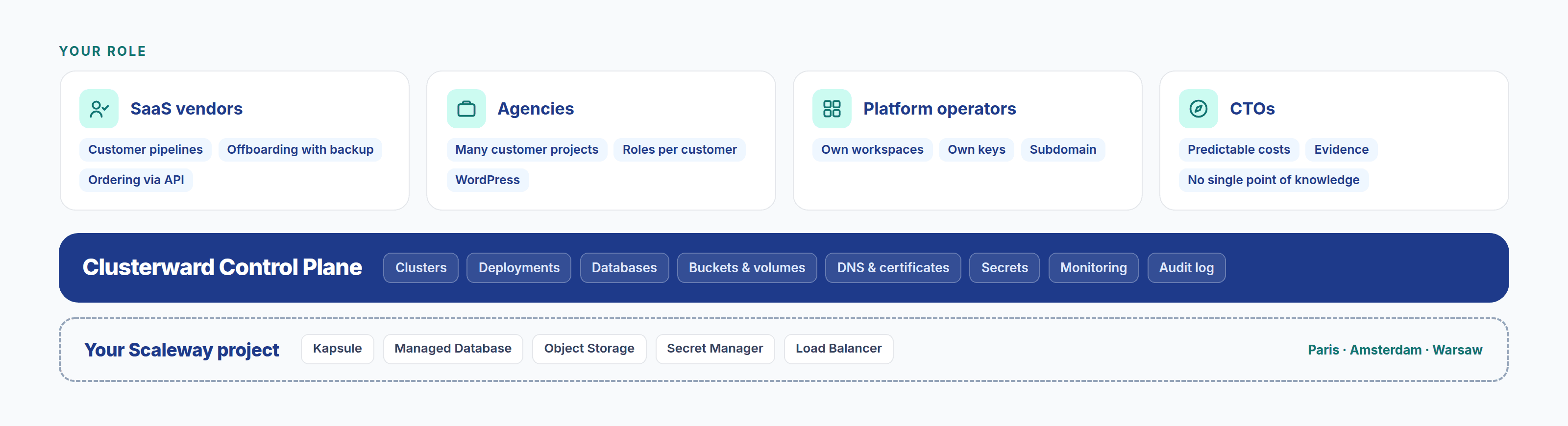
Four roles – SaaS vendors, agencies, platform operators, CTOs – on one foundation: the Clusterward Control Plane on your Scaleway project in Paris, Amsterdam or Warsaw
Four roles, one foundation: the Clusterward Control Plane on your Scaleway project
In brief

What is managed Kubernetes – and what does Kapsule alone lack?

At Scaleway, managed Kubernetes means Kapsule runs the control plane: the API server, scheduler and etcd. Everything above that remains your job – networking, ingress, certificates, deployments, databases, secrets, customers, backups and monitoring. Clusterward takes over exactly that layer, so you get truly managed Kubernetes rather than just a managed cluster.

The difference shows on day one: an empty Kapsule cluster has no ingress, no certificates, no database connection and no way to roll out an application from Git. With Clusterward, all of that is in place before the first application arrives.

At a glance

Base
Scaleway Kapsule in your own project
Regions
Paris, Amsterdam, Warsaw
Roles
SaaS, agencies, platform operators, CTOs
Occasions
Migration, NIS2, sovereignty
Getting started
Demo, then a 30-day trial with two clusters
Price
From €99 per month, only clusters count
By role

Which solution fits your role?

The same foundation, different priorities – depending on what you need Kubernetes for.

SaaS vendors

Every new customer is a pipeline run: their own database, buckets, domain and application from a template, live in under a minute. Your application can order customers itself, and offboarding backs up first, then tears down.

Go to SaaS vendors

Agencies & studios

Many client projects in one cockpit, grouped and with roles per client. Deployments from Git, WordPress from the catalog, backups and uptime checks for every site – without separate scripts for every project.

Go to Agencies & studios

Platform operators

You run Clusterward yourself for your customers: each gets their own workspace with their own database, their own key, their own backup bucket and their own subdomain.

Go to Platform operators

CTOs & technical leads

Predictable costs per cluster, operations that don’t depend on one person, no lock-in and evidence for every audit – without building a platform team of your own.

Go to the page for CTOs
By occasion

What brings you to Clusterward?

Often it’s not a fresh start but a migration, an audit or a fundamental decision.

Moving from AWS, Azure or Google Cloud

Clusters secure by default, databases imported from RDS & co., buckets copied from S3 and hosts moved one by one – the old environment keeps running until the very end.

Explore the move to Scaleway

Migrating from Qovery

Connect existing clusters, take over applications, import data and move step by step – without a big bang and at a fraction of the price.

Explore migrating from Qovery

Audit & NIS2

Mandatory 2FA, roles, an audit log of every change, encrypted secrets and tested backups: your operations produce the evidence auditors and customers want to see.

Go to Audit & NIS2

Digital sovereignty

Clusters, databases and buckets in EU data centers of a European provider, in your own project, with export and no lock-in.

Go to Digital sovereignty
Priorities

Which features does each role need?

Every feature is included on every plan. The table shows what is usually at the center for each role.

FeatureSaaSAgencyPlatformCTO
Customer pipelinesCoreFor recurring setupsFor workspacesOverview
Deployments & rollbackDailyDailyDailyTeam velocity
Databases & backupsPer customerPer projectPer workspaceEvidence
Roles & application scopeTeamPer customerPer workspaceAccess control
Logs, uptime & alertsFor every customerFor every siteFor the platformOperational reliability
Secrets & audit logMandatoryFor customer dataPer workspaceAudit, NIS2
In five steps

How does getting started work?

  1. 01

    Demo

    We show Clusterward on your use case and clarify what you need.

  2. 02

    Connect your project

    An IAM key for your Scaleway project, checked before it is saved.

  3. 03

    First cluster

    Kapsule secure by default, or you connect an existing cluster.

  4. 04

    First application

    From Git, an image, a chart or the app catalog, with a database and domain.

  5. 05

    Trial

    30 days with two clusters, then the plan that matches your number of clusters.

The foundation

What do all solutions have in common?

Behind every role is the same Kubernetes control plane: it creates clusters, applications, databases, buckets, domains and secrets according to fixed rules and knows how they relate. That’s why offboarding a SaaS customer works on the same principle as cleaning up an agency project.

The same security applies to everyone, described under Security & access: personal accounts with mandatory 2FA, roles with application scope, an audit log of every change. And for everyone, the data lives in your own Scaleway project in the EU – more on that under Digital sovereignty.

The price depends only on the number of clusters, not on customers, users or applications: Pricing. If you want to get going right away, see Getting started.

What changes

Kapsule alone or Kapsule with Clusterward?

FAQ

Frequently asked questions about managed Kubernetes with Clusterward

  • Kapsule manages the Kubernetes control plane. Clusterward manages everything above it: networking, ingress, certificates, deployments, databases, secrets, customers, backups and monitoring. Together, that makes Kubernetes your team doesn’t have to look after itself.

Can’t find your question? Write to us – we usually reply on the same business day.

Ask a question

Which solution is right for you?

In the demo, we look at your role and what brings you to us, and show Clusterward on your use case.