
Clusterward
New in Clusterward

Kubernetes node pools on demand: capacity for one purpose, for as long as it is needed

With a pool claim you state which nodes a purpose needs – for a scanner, a batch run or a single tenant. Clusterward creates a Kapsule node pool of its own for it, keeps it matching and releases it again. Ephemeral claims start from zero nodes and release themselves when idle, so you pay only while they are used.

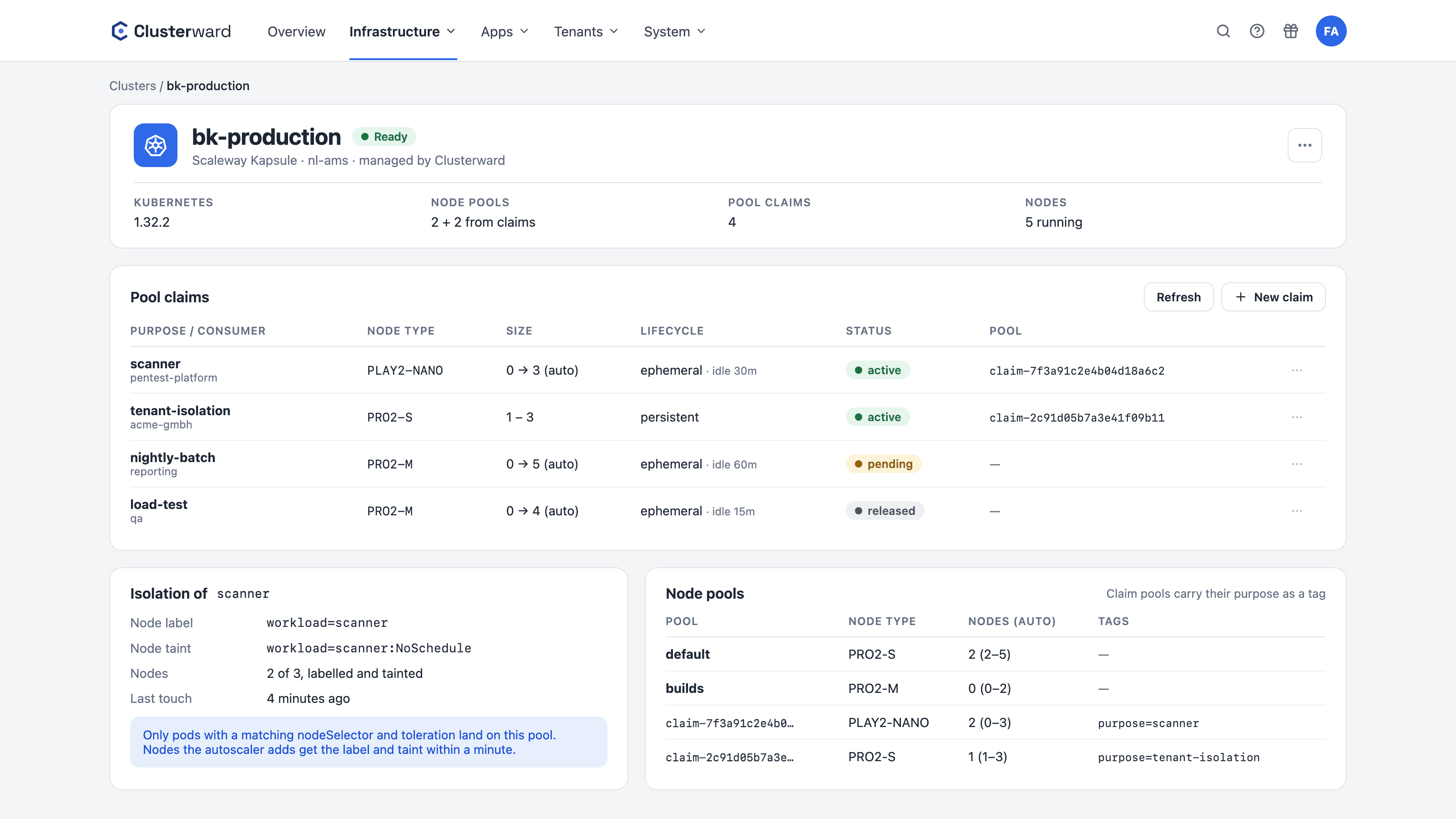
The “Pool claims” card on the cluster page of the Clusterward cockpit
The “Pool claims” card on the cluster page of the Clusterward cockpit with ephemeral and persistent claims (simplified illustration)
Illustration: a simplified view. The product shows more details and options.
In short

What is a pool claim?

A pool claim is a request for node capacity of its own on a cluster that Clusterward created. You state who needs it and what for, the node type and the maximum number of nodes. Clusterward turns it into a real Kapsule node pool, tags it with its purpose and keeps it in line with the claim: create, adjust the bounds, release. With a label and a taint the pool belongs to that purpose alone.

At a glance

Where
Clusters that Clusterward created
Inputs
Purpose, consumer, node type, size
Lifecycle
ephemeral (from 0 nodes) or persistent
Isolation
Node label and taint
Release
after an idle time or via “Release…”
Size
up to 50 nodes per pool
Rights
Provisioning area; releasing needs “Manage”
How it works

From the claim to a node pool of its own

  1. 01

    Create the claim

    Cluster page → “Pool claims” → “New claim”: consumer, purpose, node type, size, lifecycle and – for isolation – label and taint.

  2. 02

    The pool appears

    Clusterward creates the Kapsule pool with autoscaling bounds and tags it with its purpose. The status changes from “pending” to “active”.

  3. 03

    Pods land there

    Pods with a matching nodeSelector and toleration run on the pool; new nodes get the label and taint within a minute.

  4. 04

    Release

    Without a heartbeat an ephemeral claim ends after its idle time; “Release…” ends any claim. Clusterward drains and deletes the pool.

Use cases

What pool claims are made for

Consumer and purpose are free text – the same mechanism serves any workload.

Scanners and pentests

Security scans run on nodes of their own instead of next to your applications – and the pool disappears once the scan is over.

Batch and compute jobs

Nightly runs or larger calculations get nodes only when pods are waiting for them. Afterwards the pool scales to zero.

One pool per tenant

A persistent claim with a label and a taint gives a customer nodes of their own – the isolation some contracts require.

Cost only while used

An ephemeral claim starts at zero nodes. The cluster autoscaler adds nodes only for waiting pods, and Clusterward releases the pool when it is idle.

Labels and taints that stay

Clusterward sets the label and the taint on every node of the pool and repeats this on every pass, also for nodes the autoscaler adds later. Foreign taints are kept.

Controlled through the API

A program creates claims through the REST API, keeps them alive with a heartbeat and releases them – with an API token whose role allows it.

Visible and traceable

The “Pool claims” card shows every claim with size, lifecycle, status and pool. Creating and releasing are recorded in the audit log.

Release safely

“Release…” asks for the claim’s name as confirmation and never touches another pool or the cluster’s default capacity.

Any Kapsule node type

You pick the Scaleway instance type that fits the purpose – from a small node for a scanner to a large machine for compute jobs.

Lifecycle

Ephemeral or persistent?

The lifecycle decides whether the pool disappears when idle or is always ready. An ephemeral claim lives as long as its consumer sends a heartbeat – “Touch (keep alive)” in the cockpit, the API’s touch call for a program. Through the API, a touch also revives a released claim.

LifecycleSizeWhen it fits
Ephemeral0 to maximum, autoscaler on demandScans, batch runs, tests – anything with a start and an end
PersistentMinimum to maximum, never below the minimumCapacity that must always be ready, e.g. a pool for one tenant
Idle timein minutes, ephemeral onlyHow long the heartbeat may be missing before the pool is released
What changes

Node pools for a purpose with and without pool claims

Facts

What you should know

Pool claims work with Kapsule clusters that Clusterward created. Pods get onto the pool when they target it with a nodeSelector and tolerate the taint; all other pods stay away.

TopicHow it is
Clusteronly Kapsule clusters created by Clusterward
Sizeup to 50 nodes per pool
Isolationup to 20 labels and 10 taints; NoSchedule, PreferNoSchedule or NoExecute
ReleasePods move to other pools if they fit; otherwise they wait
Costno extra charge at Clusterward; Scaleway bills the running nodes
RightsCreate and “Touch” with “Operate”, “Release…” with “Manage” in the provisioning area
Further reading

Pool claims in context

Pool claims complement the node pools you manage under Cluster updates by hand: there you control size and Kubernetes version, a claim takes care of capacity that comes and goes. How a cluster that runs claims is created is shown under Cluster provisioning.

For infrastructure of its own per customer, pool claims go with the tenant pipelines and the page for SaaS providers.

Related pages

What goes with it

For SaaS providers

Customer onboarding with a database, storage and domain of their own per tenant.

Go to SaaS providers
FAQ

Frequently asked questions about pool claims

  • You create and maintain an ordinary node pool yourself. A pool claim only describes what a purpose needs; Clusterward creates the pool, adjusts its bounds, sets the label and taint on every new node and releases it again. The pool carries its purpose as a tag, so it stays clear what it is for.

Your question isn’t here? Write to us – we usually reply the same working day.

Ask a question

Pool claims in the demo

We create an ephemeral claim for a scanner, show the label and taint on the nodes and let the pool disappear again when idle.