
Clusterward
For SaaS vendors

For SaaS vendors: every customer live in minutes, every departure backed up

You sell software, not operations. Clusterward sets up the database, buckets, domain and workload for every new customer, monitors operations and cleanly tears everything down at offboarding. Your application can even order customers itself.

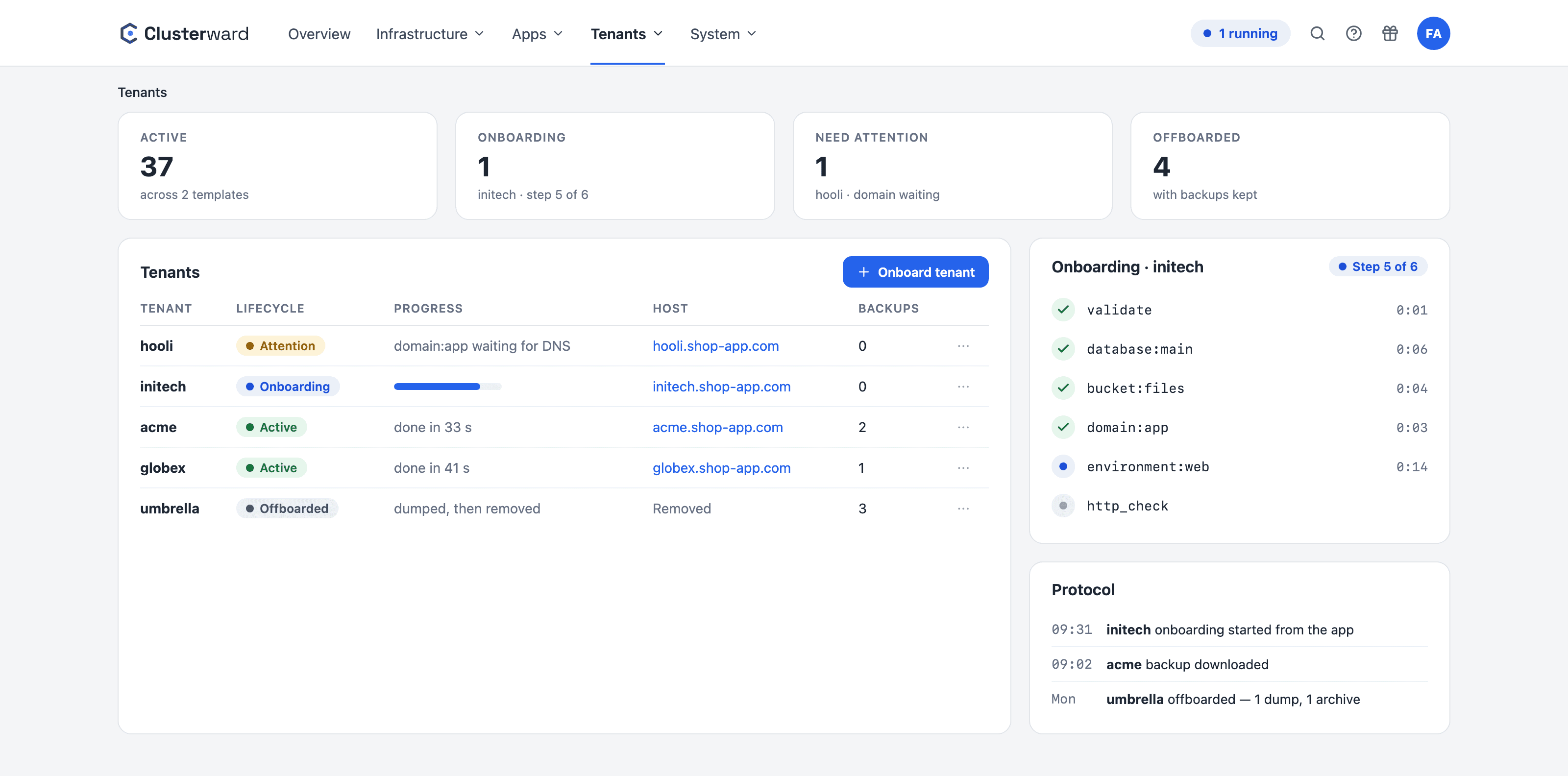
Tenants page in the cockpit: customers with lifecycle, progress of the running onboarding and log
Simplified view in the Clusterward cockpit: tenants with lifecycle and an onboarding in progress
Illustration: a simplified view. The product shows more details and options.
In brief

What Clusterward does for SaaS vendors

Clusterward is the control plane a SaaS vendor uses to run its customers on Scaleway Kubernetes. The per-customer stack is described once as a pipeline: a database on a private managed instance, a bucket pair with its own key, a host with record and certificate, a workload from your image or chart. Every new customer is one run of this pipeline, every customer its own namespace, every database its own role. Offboarding backs up first and then tears down. Your application orders customers directly through a provisioning source, without anyone opening the cockpit.

At a glance

Model
One tenant per customer, own namespace, own database
Onboarding
Pipeline built from building blocks, live in under a minute
Ordering
From the cockpit or from your application
Domains
Subdomain per customer with wildcard certificate, custom domain possible
Offboarding
Dump and archive first, then teardown
Plan
Unlimited customers, users and pipelines, only clusters count
How it works

From contract to running customer

  1. 01

    Describe the stack

    Once, in the designer: database, buckets, domain, workload, in the right order.

  2. 02

    Order a customer

    From the wizard, or automatically from your application via the provisioning source.

  3. 03

    Preflight

    Names, hosts and buckets are checked live for collisions before anything is created.

  4. 04

    Run

    Resources are created step by step, with passwords bound only at runtime.

  5. 05

    Operations

    Tenant page with hosts, deployments, backups and lifecycle, alerts via Slack or email.

  6. 06

    Offboarding

    Database dump and bucket archive into your backup bucket, then tear down in reverse order.

What’s included

What SaaS vendors get in Clusterward

The operations work between “contract signed” and “customer at work”, as data instead of a runbook.

Pipeline instead of runbook

Database, domain, bucket, environment and workload are building blocks with prerequisites and rollback. Everyone on the team can read and change the pipeline in the cockpit.

Ordering from your app

Register your application as a provisioning source: Clusterward polls it for onboarding and offboarding requests, executes them and reports the status back. No inbound machine access required.

Subdomain per customer

A wildcard certificate covers all customer subdomains, without hitting the Let’s Encrypt limit. A customer with their own domain gets their host from a single wizard input.

Data separated per customer

A dedicated database with its own role on a private instance, a dedicated bucket pair with its own key. A leaked password never reaches beyond a single customer.

Offboarding without data loss

Before anything is deleted, the dump and archive are in your backup bucket, verified. Without a backed-up dump, nothing is torn down.

Operations at a glance

Failed onboardings, unhealthy pods and expiring certificates reach your Slack or Teams channel, once per event.

Standard building blocks

What your customer stack runs on

  • Scaleway Kapsule

    Managed Kubernetes in EU data centers, private nodes, API allowlist.

  • Managed Databases

    PostgreSQL or MySQL, private network only, one database per customer.

  • Object Storage

    S3 buckets per customer with their own IAM key and bucket policy.

  • cert-manager

    Wildcard via DNS-01, mirrored into every customer namespace.

What changes

Customer onboarding with and without Clusterward

Facts

What a customer gets

Every row is a building block of your pipeline. Which ones you combine is up to your product.

ResourcePer customerAt offboarding
NamespaceIts own environment on the clusterRemoved
DatabaseDedicated database and roleDump, then drop
BucketsPublic and private, own keyArchive, then delete
HostSubdomain with wildcard or custom domainRecord removed
WorkloadYour image or chart with bus valuesUndeploy and delete
VariablesDotenv template with fresh secretsRemoved with the service
Further reading

Dig deeper

How the building blocks work is explained under Tenant pipelines. The per-customer database follows the rules from Managed databases, the host those from DNS & certificates.

Every feature is included in every plan, customers and users are unlimited, and billing is by cluster only; see Pricing.

Related pages

What goes with it

FAQ

Frequently asked questions from SaaS vendors

  • As many as your clusters can carry. Clusterward limits neither tenants nor applications nor users; the plan counts only clusters. Each customer is a namespace with its own database, buckets and host, and you set the resources per workload.

Can’t find your question? Write to us – we usually reply on the same business day.

Ask a question

Your onboarding in the demo

Bring your stack. We rebuild it as a pipeline and create the first customer together.